


How can I reuse or recycle cooking oil?
 Colleen Christensen has asked:
Is there anything one can do with rancid cooking oil?
(I don’t know how rancid she means by rancid but let’s assume she just means used and therefore slightly icky – say oil or lard from deep frying – rather than full on bleugh.)
I know that commercial fryers can recycle their old oil (for use as biodiesel) but what about domestic chefs who aren’t using anywhere near as much? And what about other uses?
Best Suggestions
- Reuse: If it’s still reasonably clean, you can use it to make soap. If it’s too far gone for that or filled with impurities from frying, you might be able to use it to make wild bird feeders – or even to encourage critters to remove an old tree stump for you.
- Recycle: Most household waste collections site (tips) in the UK collect cooking oil for recycling. Ask your local authority what the arrangements are in your area.
- See the comments below for more suggestions and ideas
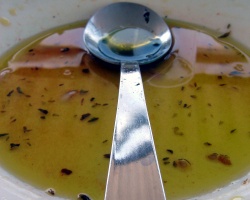
(Photo by float)
















One of the old blokes on our allotment site uses old veg oil for weather proofing exterior woodwork- fences and such.
It would make wood very flammable and smelly
One of the old blokes on our allotment site uses old veg oil for weatherproofing exterior woodwork such as fences and sheds.
Small amounts can be added to a compost bin – mixed well with paper or cardboard. Also some Council operated civic amenity sites accept cooking oil (check if there is a receptacle available first)
You can use to make soap
http://teachers.net/lessons/posts/35.html
I love making left over oil soap! Food grade oils make such nice soap.
how do you make soap from oil?
I read in a gardening book that you soak newspapers with used cooking oil. Then use it as a bottom layer before mulching. It froms a better barrier against weeds.
If she really does mean simply used and not truely rancid, she can strain it through cheese cloth and reuse it.
A diesel engine can be run on almost any type of oil
Not true I’m afraid, it clogs up the injectors in some Ford and Rover engines. Works best in Pug’ and Citroen turbos. Mix with at least, 2 parts diesel to 1 part oil. It does however lower emissions and gives a smoother running engine, but smells like a mobile chippie!
Both NeilM & Matt are wrong I’m afraid I have been running my citroen xantia (bosch pumped) on recycled waste veg oil for three years so far, it is perfectly legal in the uk, just visit
http://www.vegetableoildiesel.co.uk/forum for the requirements, warnings and usage limits and save yourself a packet.
why do people get away with scaremongering when in fact they nothing at all about a particular subject?
Only works with certain makes, mainly Bosch pumps. Check with Puegeot manuals. All untreated biofuel waxes and blocks injectors below 10C unless mixed with dino diesel.
not legally you must only run your diesel car on fuel from the pumps in the uk
Don’t the Inland Revenue get a bit upset if you use oil that duty has not been paid on?
I have a feeling that people using fat from chip shops for diesel engines have to jump through all sorts of hoops to use it legally.
again not true.
My mum uses her old chip pan oil (which goes solid at room temperatures) to make wild bird feeders.
She mixes old seeds and nuts into the fat then pours it into waste containers from the kitchen (like mushroom trays or ready meal dishes).
You can shave with olive oil, though I’d expect you’d want to use clean oil – maybe out of date stuff?
Charcoal grill. Loosely wad paper, add charcoal, pour outdated or used cooking oil over all then light. MUCH better than icky taste and smell of lighter fluid. (I made charcoal chimney out of 3 lb coffee can.)
Fireplace, same as above for charcoal.
You can clean the oil by placing it in a jar with equal parts water and oil.
Put it in the sun for 2 days and shake it whenever you think about it. The water will become cloudy with the impurities. Let it settle then pour off the oil. Repeat as many times as necessary.
If you only used it for vege cooking it’s on to use for cooking again. If it was used for meat then consider using it as an oil paint thiner, home made ingredient for soap or hand moisturizer.
Hi
make soap with some essential oil to disguise the fried smell.
esterize to produce biodiesel and glycerine. glycerine can then be mixed with unused oil to make soap (coconut oil is best) and biodiesel can be used neat in diesel engines. change the fuel filter after the first few tanks and make sure the engine has no rubber parts (if older than 1992).
above all – don’t reuse for cooking. once heated more than a couple of times the molecular bonds change creating trans fatty acids which stick to the inside of arteries and cause more problems than saturated fat.
cheers
Dear Gina,
can you advise how much Methanol and Sodium Hydroxid shall be added to 10 litres of Used Veg Oil to make an oil fuel? Hope you know.
Thanks, Regards, William
from the dollar stretcher: http://www.stretcher.com
Stump Removal
To remove a stump for free, just pour any salty, oily cooking liquid onto the area you want removed. Bacon grease is especially effective. The small gnawing animals will come out and chew the wood to get the salt and oil. A large porcupine can chew up to three inches off a section all by himself. They are notorious for destroying wooden tool handles to get the salt left from sweat.
I am working on stump number three of six on my neighbor’s property. It has taken five years to destroy two large pine stumps and number three is about 50% gone. You cannot even see where the first one was, the second is hard to spot, and the third is going fast.
–hope this helps?
john b wrote:
January 24th, 2007 at 3:34 pm
“One of the old blokes on our allotment site uses old veg oil for weather proofing exterior woodwork- fences and such.”
So wouldn’t there be a risk the fences get eaten by critters too?
Use the Fat Trap to responsibly dispose of waste fat and grease from cooking!
http://www.lessmess.co.uk
for further information on fat, oil and grease disposal
I have kept a big bottle of used cooking oil to take to the recycle and I always forget it. It is so rancid and smelly, it almost made me sick. Really bad. I keep adding more oil as I cook. Will they still take this at a recycle place? It has a place for used cooking oil but if I have to dump it I won’t be able to. Thank you. Carol Derochie.
If you use a lot of oil you could buy a Vito oil filter machine which cleans it and doubles its useable life.
Re use of oil for cooking multiplies the levels of Aldehydes which are a poison to humans, From my understanding the worst are the polyunsaturates so long thought good for us and still good for us raw such as sunflower oil, the best for cooking with the lowest levels of Aldehydes produced are Lard, butter and coconut oil. But multiple uses multiplies these poisons with each cooking.
There are lots of studies about this. I am just surprised crisp manufacturers still predominantly use sunflower oil for multiple fryings. I now rarely eat crisps. I don’t know of any processes to remove such poisons so that oil may be reused for cooking safely but health conscious people should consider this aspect
Hello,
I’m in California and didn’t want to throw out my old cooking oil. Is there somewhere I can take it or will someone pick it up?
Thanks,
Mario
Drop it off at your local Sonic. They have a used oil bin that they have collected intermittently. I think they actually make a little money off of it, so it’s a win- win situation. And if you’re asking yourself if they reuse it for cooking, no they don’t. Additionally, by adding your oil to their bin you generate curiosity- people will pick up on your example and bring theirs as well.
What about vegetable oil that’s actually rancid (really old, with rancid smell)? Can I pour that into the dirt so as to recycle the empty plastic bottle, or do I need to throw the full bottle away? Thank you.
I have recently finished a website project for Living Fuels which allows you to search for local recycling points for used cooking oil.
Why not give it a try!
http://www.livingfuels.co.uk
Hi George
The website is very useful – I can get to Regis Road to recycle my oil. Do you think there’s scope for more local drop-off points for domestic oil recycling? There’s one local restaurant near me in N London that does this. Are there ways more could be involved and do you know the barriers, eg legal, financial?
THANK YOU! I have been looking for the oil recycling places for ages. And only 3 miles from me.
Thank you!!
An example of a successful cooking oil recycling pilot program at Boston University:
“Recycle That Cooking Oil”
Pilot program hopes to connect Fryolators to boiler rooms
http://www.bu.edu/today/2009/09/28/recycling-cooking-oil
The Dec 30, 2008 query about truly rancid oil remains unanswered. I too would like to know. I don’t use oil fast enough. I’ll buy a fresh bottle of oil, and use a few teaspoons from each over a few weeks, before the whole bottle turns rancid sitting in my cupboard.
Besides lighting a BBQ or fireplace fire, is there any other use or way to recycle? The oil is “clean” as in, never having been used, but truly rancid, as in bad-smelling and tasting. Help, please?
Freeze it, buy smaller bottles, put it in a bottle or a jar with no air space
I have been running my aspace for two years now on old veg oil, which has been heavily modified. I also now of others that do the same. the problem now is that the bio fuel companies are more aggressive in there gathering of old oil so it is getting harder to get. So having used household oil is a win win situation.
I live at havant, hampshire bertye@live.co.uk
4CYCLE IT
I was wondering if we can apply for receiving news letters?
Go to ebay Australia and look at a store called Filters, Accessories & Equipment. They sell a great product for cleaning cooking oil. It’s a filter cone that goes into a stainless steel frame. Then you just pour your used cold cooking oil through it and it’s as good as new.
Thanks everyone very informative we get asked all the time if we’ll recycle cooking oil and will be in touch with living fuels very shortly.
We are currently working on a project recycling used engine oil to a low grade heating oil. There is a free collection service nationwide for anyone with 200l. Used engine oil has some potentially nasty properties so be careful moving it about.
I’d look for some information on old cooking oil as there may be implications for your health working with it as a wood treatment. We’re assured that oil engine oil is excellent at this job too.
Wondering about using cooklng oil instead of or with furnace oil.
store in cool dark place in dark bottle for longer life!
Hi everyone,
Just to make everyone aware who recycle their used cooking for free, you can actually sell it to a company such as ourselves (www.webuywasteoil.co.uk) and we will then process the waste oil accordingly.
You might as well make some money if you are planning to recycle it!
Regards,
Scott
why do you think vegetable oil has reached an all time high of £1.45 a litre in the UK, immigrants came over to take the work that our lazy dole mongers wouldn’t take and already knew that you could run your diesel on vegetable oils, as diesel prices increased many people were simply going into supermarkets and filling their tanks.
yes some fuel pumps won’t tolerate it but you can still make bio-diesel with vegetable oil to run it on those vechicles by adding lye/sodium hydroxide & methanol but this is very dangerous process there are some dodgy bio-diesel processors being sold on eBay and good sensible advice is always paramount when making bio-diesel.
as for it being illegal that’s a load of rubbish as well,In the UK anyone can burn up to 2,495 litres of vegetable oil a year in their car (providing it is suitable) Tax free that’s a cool 555 gallons of fuel.
if your car does around 60 mpg then that’s over 33,000 miles, cleaning the oil by filtering it can mean it costs as little as 10p to process or as much as 70p to process, I’d still rather pay 70p a litre that the current £1.38 for diesel.
Mileage is similar to that of diesel and it is necessary to add 5 or 10% petrol to the oil in the winter to aid starting because veg oil doesn’t have any anti-freeze in it and becomes thicker when the weather is colder, in the summer months you can simply run the car on neat filtered veg oil. people who make bio-diesel run cars that are not compatible to run on plain veg oil.
The hardest thing these days is finding a reliable supply of liquid waste vegetable oil, paperwork must be filled out and waste transfer notes must be handed out to suppliers.
so all this guff about it being illegal is a nonsense in the UK. That kind of free advice is usually born of jealousy and these types are the idiots who know nothing but will try it on and tell tales to the environment agency who will pay you a visit only to confirm that you are not using red diesel as fuel. which is illegal.
want to save yourself 2 to 3 grand a year? my filter system is a bit more technical and initially cost £200 to set up but paid for itself in three months. so if you have half a day a week to spare you could save yourself a packet and prevent a lot of waste veg being tipped down the drains at the back of restaurants and takeaways which ultimately ends up in our watercourses and rivers.
the cost of filling my 2.0 litre diesel tank these days is around £15 a tankful against £89 for ordinary diesel. I even had a jealous neighbor try to report me for filling the car up with anything but road diesel the inspectors sent me a report certificating my veg oil process as safe and meeting current regulations, no further action was taken. if you exceed the 2,495 litre per year allowance then you pay tax on the whole amount, this is why it is important to keep records of usage.
all the waste solids I create from the filtering process is collected free by a bio-diesel maker so there is no waste left unprocessed, the by product from making bio-diesel is soap, the soap can be used in garages/gardens to wash your hands in.
So lets have no more of this it is illegal nonsense do the if your interested do the research and dont take the word of someone who clearly doesn’t know what he/she is talking about.
I just get a sieve with a bit of kitchen roll in and filter the oil back into a jug. Goes completely clean again no bother.
Another use for used cooking oil is as a lubricant for a chain saw’s bar. It is environ friendly, lubes well, safer (operator not breathing in atomized petroleum oil)…and tests done by chain saw mfgrs concur it’s use. In some contries canola oil etc is mandatory as chain saw bar lubricant.
If you are into bear hunting it works amazing! ! The more rancid the better
yes Ive heard if you smear the rancid oil all over yourself the bear will hunt you instead so all you have to do is go to the forest and sit still with your gun…Lazy Hunting.
Garden tools, lube oil, mower blades- stop grass sticking-around termite prone timbers – they hate any oil- wood preserver – 1 part Cooking oil to 2 parts sump oil-else it will mold- DON’T REUSE IT FOR COOKING- It can look clean but it has been denatured and it is not something you want to consume at all esp as the stuff is so cheap to buy.