


How can I reuse or recycle … a bag of plaster?
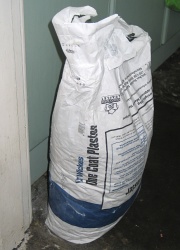 We had our leaky roof fixed last week and needed to replaster the leak-damaged part of the ceiling in the attic room. Our plasterer could only find giant bags of plaster for sale but it was only a small bit that needed fixing, so we’ve got about 20kg of powdered plaster left.
The plasterer said he won’t be able to use it before it went solid so he left it with us: we figured we’d be able to get rid of it one way or another.
I’ve put it on our local Freecycle group with the hope that someone can use it but if it doesn’t disappear down that route, anyone got any suggestions on how we can reuse or recycle it in the next few weeks? Or does anyone know any way to stop it going solid – will an airtight container suffice?
According to the bag, it’s “one coat plaster” that is “suitable for most internal surfaces” but we have no internal surfaces that need plastering. Can it be used for craft things or is that a whole different type of plaster?















It’s a different kind of plaster. One Coat (specifically that one coat) needs something other than itself to adhere to.
Thanks. I thought it would be different but I really know nothing about that sort of thing :)
-louisa
Plaster is calcium sulphate.
As the dry powder it is CaSO4.0.5H2O.
When mixed with water it reacts with the water to produce CaSO4.2H2O.
It can absorb water from the atmosphere – that is why it will go hard after a while, and also loose its effectiveness even before it is fully hard. Keeping it in a dry place tightly wrapped in a plastic bag should extend its life.
If you eventually have to dispose of it, it is not toxic, and indeed plants can make use of it as a fertiliser to some extent, so scattering it around somewhere not very special (eg on a rough track) might be preferable to casting it into landfill. You can easily break it up with a hammer even if it has set hard. Good luck!
One coat plaster……if it is a “hot-mud” (hot-mud sets up by itself in 10-90 minutes) it can be used anywhere you would use plaster of paris….to fill molds. Make your own “Tiles” by making molds(out of the plaster) from real tiles and then sealing them and making faux tiles from the plaster. Sand the faux tiles and paint with 4 coats of acrylic spray paint. Add designs if desired. You make make “tiles” for the back-splash for about $2/50 this way.
Air dry plaster is more specialized. Either transfer it to a moisture-proof bag or use it to create surface textures on you walls.
Look around for house renovations in your area – you can offer it to your neighbour, and win some friends:-) Or call your local shelter or day care centre – they maybe in need of some plaster. But Freecycle usually works for stuff like this. I am sure it will be snapped in no time. If not able to give away in one group – subscribe for a next nearest one – people sometimes don’t mind to travel a bit for free stuff!